


I spent the whole summer of 2015 doing experiments shaking the camera horizontally, vertically and circular movements. Actually I got obsessed doing so. 🙂
I had very slow shutter time and very low light in that process.
I spent the whole summer of 2015 doing experiments shaking the camera horizontally, vertically and circular movements. Actually I got obsessed doing so. 🙂
I had very slow shutter time and very low light in that process.
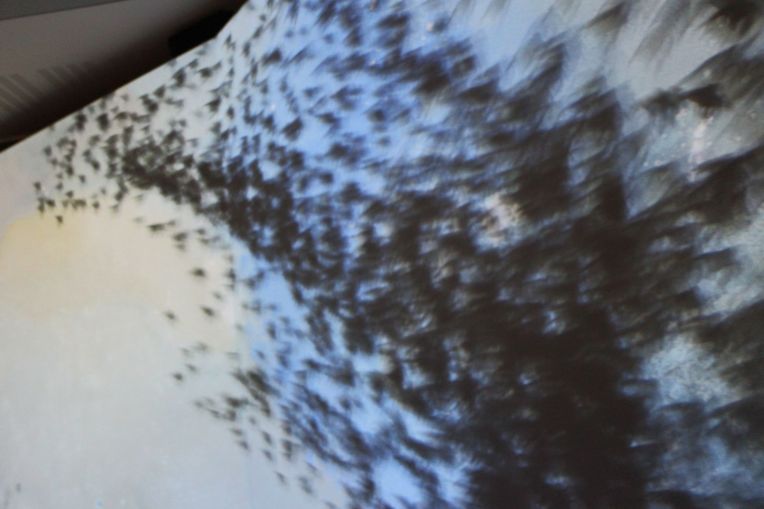
I was in Rome at Maxxi “SHAHZIA SIKANDER: ECSTASY AS SUBLIME, HEART AS VECTOR” exhibition. I got so excited with the video installation that I didn’t even remember to shot a photo of it. After we got back home I understood that I was missing the documentation, photos of the exhibition and I got angry. Then I search in my photo camera and found just this one photo. As I remember the photo camera was hanging on my neck and I think it just shot itself.


In the field of astrophotography, these images would be regarded as mistakes. However, I am interested in the idea of celestial objects “drawing” onto photosensitive material, whether onto analogue film or onto a photographic sensor. I am currently exploring the use of the word “celestography”, adapting the etymological structure of the word “photograph”. Celestography means to “draw from the heavens”, I find it highly inspiring to consider the movements of celestial objects as gestures reciprocated onto photosensitive film. The “errors” included in this series include the movement of the camera whilst imaging the Moon, leaving a looped trace of condensed moonlight. Zoomed In On Orion’s Belt requires the opposite, a camera remaining still on the Earth as it spins. The analogue star trails image is scarred by scratches and fingerprints, which indicates my presence. My memory of creating this image is much more evocative than the others, because my senses were engaged in different ways. I was in darkness for both the exposure and the development of the image, my sense of touch was incredibly important to feel for the shutter button, the structure of the spool and the tacky surface of the film.
Overall, I find these images beautiful in the simplicity of their composition, though they represent incomprehensibly vast and distant objects.
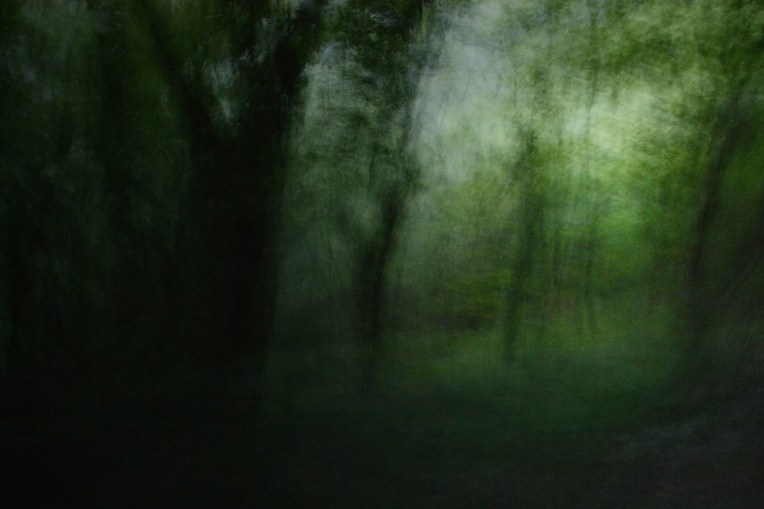
My image is called Forest Movement and was taken in Derbyshire. There is something magical about walking amongst trees and under their green canopy but at the same time, there lies deep fear about forests in the human psyche, I wanted to purposely capture the feeling of movement walking through trees, the magical aspects of nature and ‘greenness’ but also the dark fears. I love playing with long exposure- slow shutter speeds for interesting, dreamy and surreal – almost 3D effects.
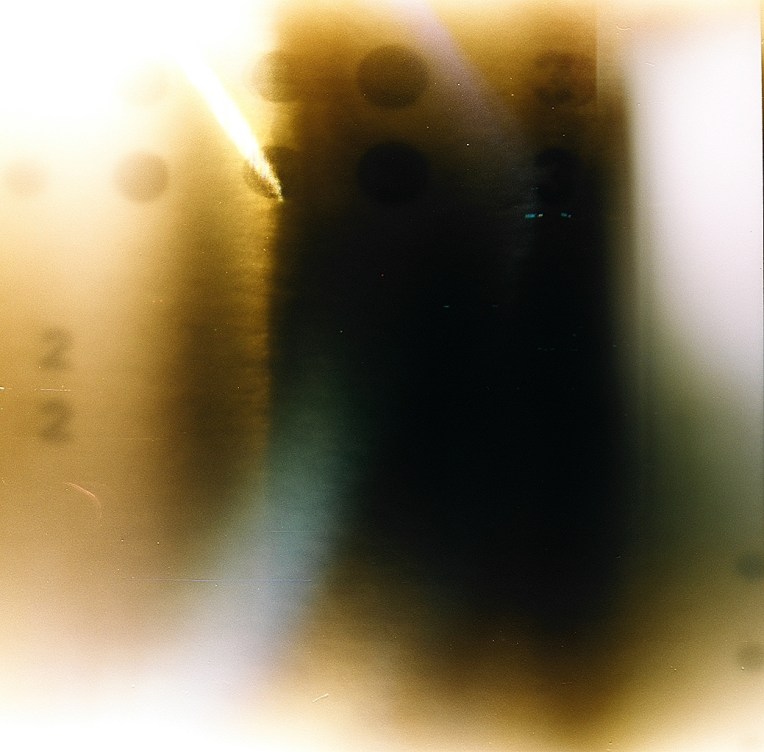
This image was taken with a Diana F+ Camera. The back of the camera came loose in my bag, at the time I was so disappointed but I decided to get the roll of 120 film developed anyway. I really like the colours, and sense of movement in the shot, even though I didn’t capture what I wanted at the time.


The error is intentional because of the work in progress of my art project described below, named “The Extended Photography”.
Every action is acted out as if it were part of a performance which is, at the same time, personal and collective; as a consequence, every photograph captures a moment of that performance. Absolute photography is not about documenting a face through pictures taken every day; on the contrary, it is about an individual who has been concealed to sight since the day he was born and who shows himself to others – throughout his life – exclusively through photographs. In other words, that is how pictures could properly bear witness to absence, since – in photography – the concept of presence has a negative meaning. This amounts to saying that, without absence, photography could exist only in part; it is like the colour black, which is present in every other colour but – at the same
time – can be seen only when all the other colours are absent. The proof is that the individual who lends himself to the fulfillment of absolute photography can give a concrete proof of himself only at the very moment when (his) life is denied: death.
Paradoxically, the conflict between presence and absence in photography can be solved by taking pictures of something that does not exist, a figment of the imagination – with the same kind of freedom which usually belongs to forms of art like painting and drawing.
It is here that my work as a photographer comes into play: turning pictures of real subjects into something absurd and unreal by losing the ability to portray, witness, describe, illustrate. This is possible only if we separate the image from the picture: what we obtain is a series of objects which are independent from photography and, conceptually, “unphotographable”. To think that reality is what we see in a picture is the easiest and most commonly accepted solution; yet, it is the result of a psychic distortion.
What we have here, instead, is the chance to create images that are the outcome of other images (that is, images that are not real but imagined); to show something which is totally absent. This reflection – which is a short explanation of photography in general and of my work as a photographer in particular – is, essentially, a somewhat messy approach to the concept of image we are fed everyday, and the reason is that the way we are taught to look at reality is aberrant and one-dimensional.
As a consequence, we are mentally bound to a distorted idea of the use of the image and of its function – and, therefore, of photography (because the boundaries between ideal and real are so vague); yet, we are so deeply linked to this idea of photography (because that is what we are taught) that we assume it to be real just as we do for any other optical illusion.
The perfect conclusion for this paradox would be to invent an absolute camera: a device that, with every shot, replicates the same image over and over. This would be the only exhaustive role for photography: to endlessly reproduce itself.
The main issue, therefore, is how we aesthetically relate to reality; in other words, to admit that every aspect of a relationship (with reality, with the others) is a representation which would cease to be so if only we gave up conventions. Yet, if this were possible, new conventions would arise which, in turn, would shape other representations; and since it is not possible for us not to create representations and, therefore, to see reality differently than in the aforementioned one-dimensional way, our use of photography can be all
but partial.
As a consequence, we are not able to understand the positive way in which photography interferes with our conventions… Photography is somewhat of an alien. The ambition to bring an image to a further, successive level implies the creation of new perceptual
realities. Every action undertaken in this light increases the difference between the future condition of the image and its initial appearance – what we can define as “model” or “prototype”. The result of this kind of work should be seen as an enhancement that I achieve by editing the image: by overloading it with – or depriving it of – information.
Theoretically speaking, this process can be compared to overwriting the initial –primitive and less evolved– image with data which resembles that already existing on it but which is meant to be its evolution.
We are mistaken if we think that a photograph can seize a portion of reality in an image (despite the fact that our perception is not able to grasp it and, therefore, to assert its existence); we are mistaken if we think that we can even freeze an image in a precise moment of its existence (of its progressive ageing – of matter and meaning – and of its position in the context) and deny it its own history.
In my work, on the contrary, I try to force this common fate of the image. It could be said that, when I edit an image, on the one hand I try to dismantle and erase its apparent qualities – as if I needed to turn it upside down and recreate it from scratch; on the other, I try to bring it up to date (even only just to test reality or our personal perception of it) to help people recognize it in/for the present.
Sometimes I’m afraid I might be obsessed with photography, but then I realise that photographs (and here I mean prints exclusively) are not static images; on the contrary, they are constantly in motion. Pictures are living things, creatures, almost animals: full of expression (personality, I dare say), growth, cycles, chemical reactions and mistakes that can not be corrected. More than other – more static – form of arts (like painting), more than digital products, computers or sci-fi robots, photographs can be treated as another living species.


All the photographs are from a series on which I have been working for the past two years called “The 231 and the X31”.The numbers 231 and X31 are those of a bus route on which I travel and I have been taking photographs from the bus and getting off at selected bus stops to explore and document what I find.
The pictures are all taken from the bus while it is moving or stationary at the bus stops.
Most of these photographs are blurred or affected by the bus window but the ones here are those which I definitely would not use because they are over or under exposed, too blurred or there just isn’t enough information. So you could say I contributed to the errors by taking pictures from a moving vehicle but within the parameters I have set some errors are acceptable but sometimes the bus driver would accelerate or drive over a bump or the light was just not right.
The pictures are a cross section of the areas that I photographed. Though I photograph consistently along the bus route there are some areas, for example a stream which is only visible for about ten seconds, which I tried to photograph regularly.


Whilst on an extended four month road trip through Europe in a van with my wife and new born baby I had a falling out with photography when some project didn’t go as planned. I still needed to capture some images of family life but didn’t really want to think to much about using my proper kit so I resorted to just using my Iphone 4s to catch moments without really thinking about it, a camera I had never really paid much attention to in the past and wasn’t really paying to much attention to when taking these.
After a while and a few blurry and out of focus images I decided I liked the aesthetic and went with it, the only post production is to convert to black and white and up the contrast.
 In Pursuit of Error