A really interesting blog post from Toby Lattimore, a recent IPE contributor, on the nature of the photographic error. It’s interesting to hear other photographers’ thoughts on this subject, as makers, viewers and appraisers of ‘good’ and ‘bad’ photographs. Perhaps we can get a conversation going!
Author: tracypiperwright
Up close
Finger trouble


Low light and finger trouble during a trip to Nottingham. iPhone Photos kindly donated to the project by Amanda Spencer.
Fuzzy selfie


I took my own SLR (single-lens reflex camera) through an camera lens (focus lens), as well as an invisible mirror for a new practice and/or artistic simulation of the self-portrait. However, a digital camera towards the IR (infrared) photography in front of my eyes. It’s taking pictures with the light which is outside the spectrum that they are unable to see with our own eyes. Therefore, this light is too sensitive to our sense in the dark. it’s difficult to keep front of the IR photography through the SLR.
Shifting trees
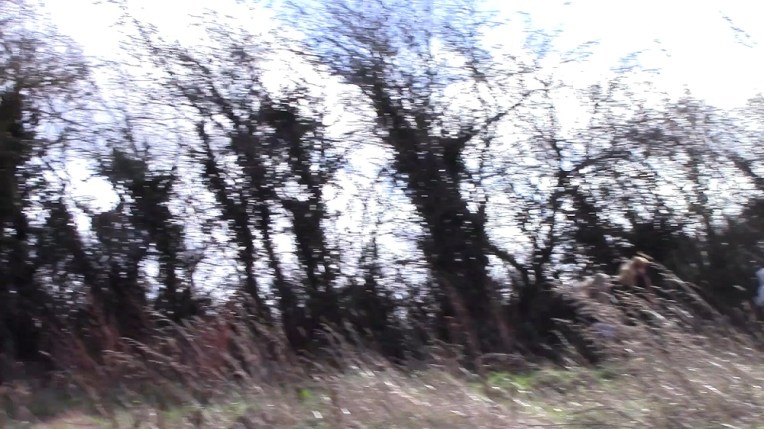
My main process is to grab frames from films I shoot in natural environments, the light often being natural and bright. The brightness often distorts or changes the flora in the image creating amorphous shapes, that twist and move. I’m fascinated about how the photograph can capture this effect even though it actually doesn’t exist in reality and is more an effect of the lens.
As I am grabbing these film stills from the footage I sometimes find an image that blurs or distorts and captures something that actually for me is very effective, that conjures up something about the experience.
This image here shows a bank of shifting trees due to the enforced error of swinging the camera around and looking for high contrast images for my painting. I actually wasn’t looking for this type of image but still may use it in some of my paintings. It has become it’s own work.
Hole in the wall
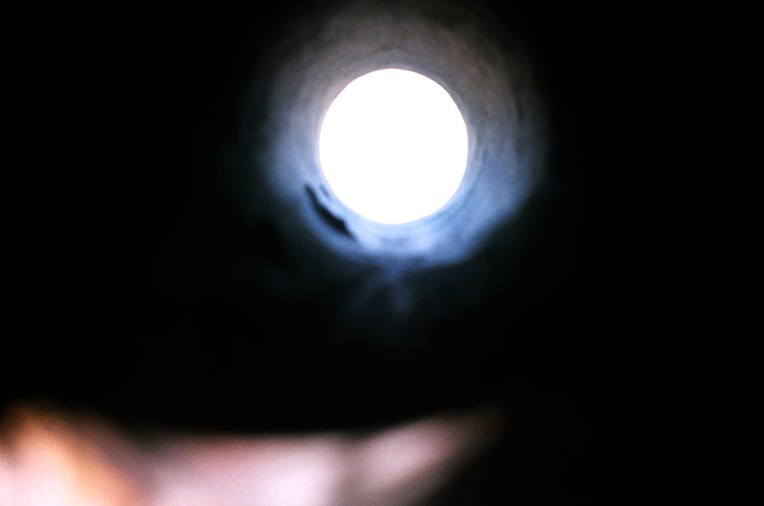
This photograph was supposed to capture an image of the sea through this hole in a wall at Margate’s old Lido.
Error Urchin

I like pushing or pulling photographic equipment. Flooding the camera with light, or leaving the shutter open too long, or juddering, or when the lights don’t sync properly.
I like revealing the tricks of photography. Showing the conditions under which the image was made.
In the case of the Error-Urchin I am embarrassed to say I cannot recall how the error came about (as is often the case). It was taken on 120 film with a Mamiya camera, but I have no further information about the anomaly.
Found film


These images are from a roll of negatives from my old box Brownie. I finished the 50 year-old film at Bryn Celli Ddu on Anglesey this June. It’s very over-exposed because I forgot that the shutter isn’t automatic; the emulsion on the negatives is damaged but you can just make out the line of the ancient burial mound.
New frontiers


What you can touch or experience is the work of art, but the art is the inner experience of the creator in that moment that manifests something into existence. Thus, what we can see or touch is not the art itself. It is the work, a surface that bears the traces of that inner experience. It is all about the inner experience. And the purpose of having any work is that the work hopefully can mirror the reaction in the viewer to whatever degree possible.
For me the camera has been another form of tool, a brush, if you may, with which I have sought to catch a source of light, a shape and paint with it, by that opening new frontiers of perception and interpretation within the depicted reality. In this sense, the error is the door through which this reality opens and for that I find photography a delighting possibility for a visual artist.
 In Pursuit of Error